| |
| |
| |
| LDAPSearch |
| Simple Search Tool to look for Objects
in the Directory |
|
| |
| |
GUI is completely redesigned to make it look pleasant and more easy to use.
Search operation is now performed in separate thread which prevents application from
hanging when the search takes more time. Also the animation movie is displayed
during search to indicate the status of operation. User can select the file
for writing as well as exporting search results.
|
| |
| It is made Vista UAC compatible. Also the current search settings
are stored in the registry which will be populated when application is
run next time. |
| |
| LDAP search timeout option is introduced along with GUI
modification. Also the results can now be directly written to the output
file instead of list box. |
| |
| First public release with the basic search features. |
| |

| |
LDAPSearch is one of the simplest
tool for remotely searching on the Directory servers such as eDirectory, Active Directory etc.
Directory server provides the most scalable, high-performance LDAP
data store for critical information within the industry and serves
as the foundation for the new generation of e-business applications
and Web services.
In this context, this LDAP search tool makes it easy to look for
various information present in the Directory remotely as well as
helps in troubleshooting problems associated with the Directory
servers.
|
| |
| |
| |
|
| |
| |
|
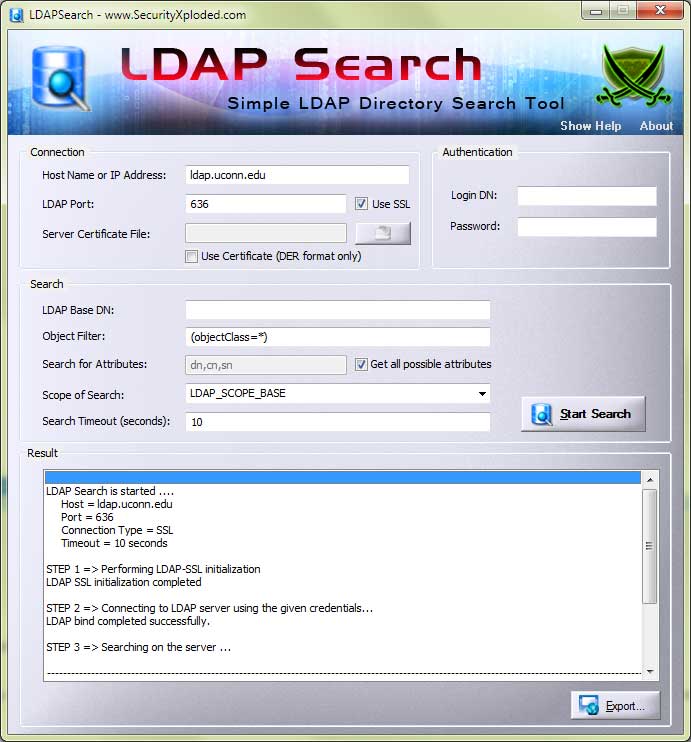
LDAPSearch is one of the easiest, fastest and lovely tool for
searching Directory servers. It provides various options to tweak
the search queries thus making the search operation more efficient.
Here are some of the salient features of LDAPSearch...
|
Supports both normal LDAP ( port 389) as well as LDAPSSL (
port 636 ) protocol. Also user can specify custom port in case the
target server is running on non standard port.
Allows user to specify server certificate during SSL connection.
This is useful when server requires client to use previously granted
certificate for identification.
Authentication credentials can be provided with ease. In case of
anonymous connection , default username and password is blank.
However you can specify other usernames such as "anonymous"
for the anonymous connection especially for Active Directory.
Following search options can be used to customize the query to
get effective results.
- Base DN: Indicates the sub object for
search operation. Base DN must follow the LDAP naming convention in specifying
the DN name. Keep it blank to search from root
object.
- Filter:
Specifies the type of object to be searched.
- Attributes:
Custom attributes can be specified so as to cut down the
search result. For retrieving all the attributes of the
object select the "Get attributes
dynamically" checkbox.
- Scope: This specifies the depth of the level to search for under
base dn. There are 3 levels. "BASE"
means only the requested object specified in the base DN will be
searched. "OneLevel" indicates that all the
objects below the base DN will be searched. "Subtree"
means all the objects under the base DN are searched recursively.
- Timeout: This controls the
time taken for LDAP search operation. While enumerating
large number of results, this value needs to be modified
accrodingly.
Search results can be directly written to the output file
instead of displaying it in the window in case of large number of
results.
User can also export the result to the file once the search
operation is completed.
|
| |
| |
| |
| LDAPSearch ver 2.1 - Windows |
| |
| |
| RemoteDirDetector: Tool to
remotely detect type of Directory server. |
| NetShareMonitor: Watch your
shares from intruders. |
| |
| |
| |
| |
| |
| |
| |