SecurityXploded.com
Mailing List Join us on Google+ Twitter facebook Youtube RSS Feeds
MailPasswordDecryptor : All-in-one Mail Password Recovery Software


MailPasswordDecryptor
 
 
See Also


Contents
 
 
About MailPasswordDecryptor
Mail Password Decryptor is the FREE software to instantly recover Mail Account passwords from popular email clients and other associated applications. You can recover your lost password for email accounts like Gmail, Yahoo Mail, Hotmail or Windows Live Mail from email applications such as Microsoft Outlook, Thunderbird, IncrediMail, GTalk etc.
Most of these applications store the login passwords so that user don't have to remember and enter the password every time. Each of these use their own local storage format and proprietary encryption mechanism to store the login passwords. MailPasswordDecryptor automatically crawls through each of these applications and instantly recovers all of the stored mail account passwords.

It presents both GUI interface & command line in a single software making it useful for Penetration testers as  well as Forensic investigators.
 
It works on wide range of platforms starting from Windows XP to latest operating system Windows 7.


Features
MailPasswordDecryptor supports recovery of Mail account passwords from following Email Clients and other associated applications
  • Microsoft Outlook Express
  • Microsoft Outlook 2002/XP/2003/2007/2010
  • Mozilla Thunderbird
  • Windows Live Mail
  • IncrediMail
  • Foxmail
  • Windows Live Messenger (including latest version 2011)
  • MSN Messenger
  • GTalk
  • GMail Notifier
  • PaltalkScene IM
  • Pidgin (Formerly Gaim) Messenger
  • Miranda Messenger
 
Here are the highlights of top features of MailPasswordDecryptor
  •  Instantly decrypt and recover stored encrypted passwords from popular email clients.
  •  Comes with both GUI interface as well as Command-line version.
  •  Recover password of any length and complexity.
  •  Automatically discovers all supported Applications and recovers all the stored passwords.
  •  Save the recovered password list to HTML/XML/Text file for transferring to other system or for future use.
  •  Easier and faster to use with its enhanced user friendly GUI interface.
  •  Support for local Installation and uninstallation of the software.
 
 
Installation & Uninstallation
MailPasswordDecryptor comes with Installer so that you can install it locally on your system for regular usage. It has intuitive setup wizard (as shown in the screenshot below) which guides you through series of steps in completion of installation. At any point of time you can use Uninstaller to remove the software from the system.
 
MailPasswordDecryptor Installer
 
At any point of time, you can uninstall the product using the Uninstaller located at following location (by default)
 
[Windows 32 bit]
C:\Program Files\SecurityXploded\MailPasswordDecryptor

[Windows 64 bit]
C:\Program Files (x86)\SecurityXploded\MailPasswordDecryptor


Using MailPasswordDecryptor
MailPasswordDecryptor is easy to use with its simple GUI interface. 

Here are the brief usage details
 
Using GUI Version
  •  Launch MailPasswordDecryptor on your system
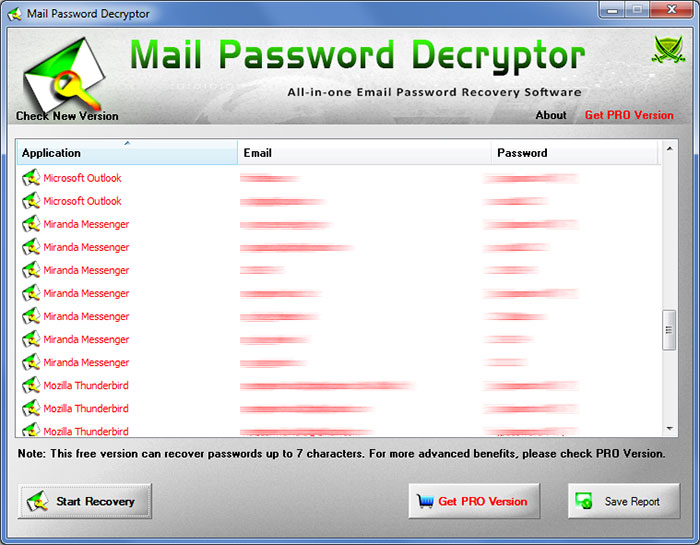
  •  Next click on 'Start Recovery' button and all stored  Mail account passwords from various applications will be recovered & displayed as shown in screenshot 1 below.
  •  By default passwords are not shown for security reasons as it is sensitive data. However you can click on'Show Password' button at the bottom to view these passwords.
  •  Finally you can save all recovered password list to HTML/XML/Text file by clicking on 'Export' button and then select the type of file from the drop down box of 'Save File Dialog'.
 
Using Command-line Version
 
Here is the typical usage of command line version
 
MailPasswordDecryptor.exe  "<output_file path>"
 
Here are some of the examples

//Writes recovered password to text file in current directory
MailPasswordDecryptor.exe  output.txt

//Writes recovered password to HTML file in current directory
MailPasswordDecryptor.exe  output.html

//Writes recovered password to XML file in current directory
MailPasswordDecryptor.exe  output.xml


//Writes recovered password to TEXT file
MailPasswordDecryptor.exe  "c:\my test\passlist"
 
It automatically detects the mode (HTML/XML/Text) by using the extension of the specified file (html/xml/txt). By default (or if no extension is specified) it uses the TEXT mode. For more examples refer to Screenshot 2 below.


Screenshots
Here are the screenshots of MailPasswordDecryptor
 
Screenshot 1:MailPasswordDecryptor is showing the recovered Mail account passwords for popular applications. Passwords are not shown being sensitive data, you can turn on by clicking on 'Show Password' button below.
 
MailPasswordDecryptor showing recovered passwords
 
 
Screenshot 2:  Command line usage of MailPasswordDecryptor showing various examples.
 
MailPasswordDecryptor
 
 
Screenshot 3:  Exported list of of recovered Mail account passwords by MailPasswordDecryptor in HTML format.
 
Exported Mail Password Accounts


Release History
Version 2.0 :  23rd Jan 2012
Generate report in XML and Text format in both GUI as well as Command-line mode.
 
Version 1.6 :  26th July 2011
Support for password recovery from Foxmail
 
Version 1.5 :  3rd June 2011
Support for Windows Live Mail & IncrediMail
 
Version 1.1 :  31st Mar 2011
Added links for PasswordForensics.com in about section and few bug fixes
 
Version 1.0 :  23rd Feb 2011
First public release of MailPasswordDecryptor


Disclaimer
MailPasswordDecryptor is not a hacking tool as it can recover only your stored passwords. It cannot recover the passwords for other users unless you have right credentials.

Like any tool its use either good or bad, depends upon the user who uses it. However Author or SecurityXploded is not responsible for any damage caused due to misuse of this tool.

Read complete License & Disclaimer terms here.


Download
 
  FREE Download MailPasswordDecryptor v2.0

License  : Freeware
Platform : Windows XP, 2003, Vista, Win7

Win 7 Compatible


See Also