| |
| |
| |
 |
| |
| |
| |
| |
| |
|
|
| |
| |
| |
|
|
|
| |
| |
|
|
Foxmail Password Decryptor is the FREE software
to instantly recover mail account passwords from Foxmail
- one of the emerging email client. |
|
|
Foxmail stores all the configured mail
account passwords in registry in an encrypted format. This software
helps in automatically discovering & recovering all such stored
passwords.
Also it supports both GUI
interface as well as Command-line version. This makes it a useful tool for
Penetration Testers and Forensic investigators.
New v2.0 can recover mail passwords stored by latest Foxmail v7.x version. Also it features manual & automatic mode of password recovery from Foxmail. Manual mode is useful when Foxmail is installed at non-standard location or when you want to recover Foxmail passwords of another system.
Foxmail Password Decryptor works on both 32 bit & 64bit Windows platforms starting from Windows XP to Windows 8.
|
| |
| |
| |
|
| Here are the main features |
- Instantly recover mail passwords from all versions of Foxmail
v6.x to v7.x
- Supports Automatic
& Manual mode of Password Recovery
- Recover
all type of mail passwords including POP3/SMTP.
- Automatically scan for Foxmail Account file in all drives on the system.
- Presents both GUI and Command-line Interface.
- Useful for Penetration Testers & Forensic
investigators.
- Backup the recovered mail password list to HTML/XML/TEXT file.
- Support for local Installation and uninstallation of the
software.
|
| |
| |
|
| Foxmail [version 6.5] stores
all the configured mail account password information at following
location, |
| |
|
C:\Program Files\Foxmail\mail\<account_emailaddress>\Account.stg
|
| |
This "Account.stg" file
appears to be in binary format as first 0x800 bytes are filled with some
hex data then follows the actual account information including POP3 and
SMTP account passwords.POP3 & SMTP account passwords are stored by the
name 'POP3Password' & 'ESMTPPassword' respectively. The passwords are stored in hex
format and XOR encoded using the magic string "~draGon~". |
Foxmail v7.0 or higher stores all the account password information at new file "Accounts.tdat" using differnet storage format. Also it uses the new magic string "~F@7%m$~" but with the same encryption algorithm. Here is the default account file location, |
|
C:\Program Files\Foxmail 7.0\Data\AccCfg\Accounts.tdat
|
| |
| |
| |
|
| It comes with simple Instaler that helps you to install it locally
on your system for regular usage. It has intuitive setup wizard which guides you through series of steps
in completion of installation. |
| |
| At any point of time, you can uninstall the product using the
Uninstaller located at following location (by default) |
| |
[Windows 32 bit]
C:\Program Files\SecurityXploded\FoxmailPasswordDecryptor
[Windows 64 bit]
C:\Program Files
(x86)\SecurityXploded\FoxmailPasswordDecryptor |
| |
| |
| |
|
FoxmailPasswordDecryptor easy to use with its simple GUI interface.
For advanced users & Penetration testers, it also comes with command
line interface.
Here are the brief usage details for both GUI and
command line version. |
|
|
- Launch FoxmailPasswordDecryptor on your system after
the installation.
- Next click on 'Start Recovery'
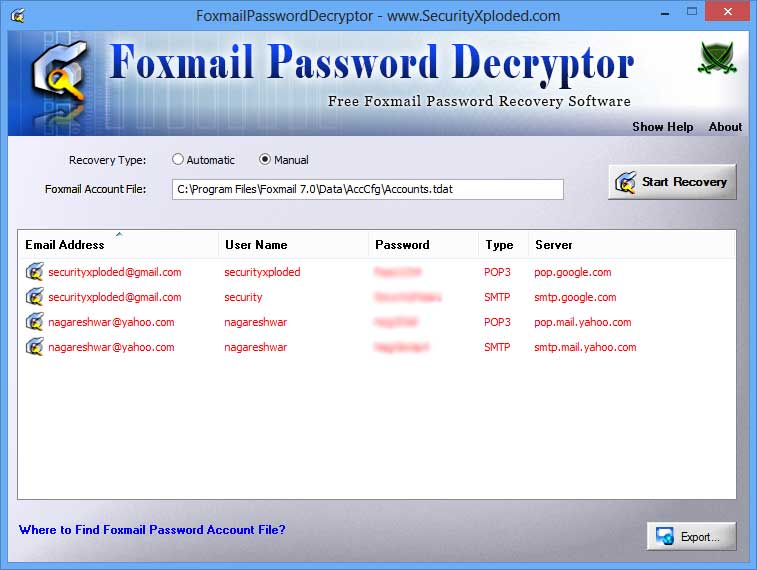
button. Instantly all the stored web server login passwords will be cracked & displayed as shown in screenshot 1
below.
- By default passwords are not displayed being sensitive data. To
view the actual password click on "Show Password"
button.
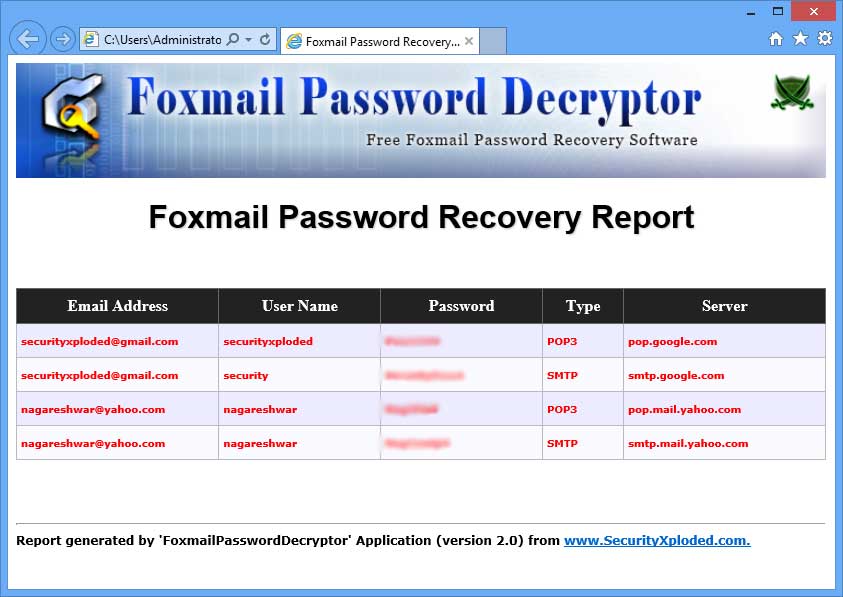
- Finally you can save all recovered password list to HTML/XML/Text file by clicking on 'Export' button and then select the type
of file from the drop down box of 'Save File Dialog'.
|
|
|
|
|
|
|
|
Here is the typical usage of command line version |
|
|
|
FoxmailPasswordDecryptor.exe "<output_file path>" |
|
|
|
Here are some of the examples |
//Writes recovered
password to text file in current directory
FoxmailPasswordDecryptor.exe output.txt
//Writes recovered
password to HTML file in current directory
FoxmailPasswordDecryptor.exe output.html
//Writes recovered
password to XML file in current directory
FoxmailPasswordDecryptor.exe output.xml
//Writes recovered
password to TEXT file FoxmailPasswordDecryptor.exe "c:\my
test\passlist" |
| |
| It automatically detects the mode (HTML/TEXT) by using the extension
of the specified file (html/txt). By default (or if no extension is
specified) it uses the TEXT mode. For more examples refer to Screenshot 2
below. |
|
|
|
|
|
|
|
| Here are the screenshots of
FoxmailPasswordDecryptor |
| |
| Screenshot 1: FoxmailPasswordDecryptor is showing the
recovered mail account passwords from
Foxmail . |
| |
 |
| |
| |
| Screenshot 2: Command line usage of FoxmailPasswordDecryptor
showing various examples. |
| |
 |
| |
| |
| Screenshot 3: Exported list of of recovered
passwords by
FoxmailPasswordDecryptor in HTML format. |
| |
 |
| |
| |
| |
|
| Now it can recover passwords from Foxmail v7.x. Supports manual & automatic mode of password recovery. Quick Drag & Drop of foxmail account file. |
| |
| Improved user interface with new banner. Now you can generate password report in XML/TEXT format in addition to existing HTML format. |
| |
| First public release of FoxmailPasswordDecryptor |
| |
| |

|
| |
|
FoxmailPasswordDecryptor is not a hacking tool as it can recover only
your stored passwords. It cannot recover the passwords for other users
unless you have right credentials.
Like any tool its use either good or
bad, depends upon the user who uses it. However Author or
SecurityXploded is not
responsible for any damage caused due to misuse of this tool.
Read complete License & Disclaimer terms
here. |
| |
| |
| |
|
|
|
| |
| |
| |
| |
|
|
|