Application security has not become harder because vulnerabilities are more sophisticated. It has become harder because modern systems generate more security signals than teams can realistically interpret. Over the past decade, organizations have successfully embedded security across the development lifecycle. Static analysis scans code continuously. Dependency scanners track open-source risk. Dynamic testing evaluates runtime behavior. CI/CD pipelines integrate security checks at every stage. On paper, coverage has never been stronger.
In practice, this has created a different problem: decision overload. Security teams are no longer limited by visibility. They are limited by their ability to determine what matters. Hundreds of findings can emerge from a single release cycle. Many are valid. Few are urgent. Without context, prioritization becomes inconsistent, remediation slows down, and engineering teams disengage.
AI AppSec tools exist to solve this exact problem. They do not replace scanning engines. They operate above them, acting as interpretation layers that connect findings to architecture, usage, exposure, and ownership. Instead of producing more alerts, they reduce ambiguity. In 2026, the most effective AppSec tools are not the ones that detect the most vulnerabilities. They are the ones that help organizations act on the right ones.
At a Glance: 7 Best AI AppSec Tools in 2026
Apiiro – Best Overall AI AppSec Platform
Snyk – Developer-first AI vulnerability prioritization
Semgrep – Fast, AI-enhanced static analysis
Checkmarx – Deep code-level AI security analysis
Veracode – Policy-driven AI AppSec governance
StackHawk – API-focused AI dynamic testing
PentestGPT – AI-augmented penetration testing
How We Evaluated AI AppSec Tools
To avoid surface-level comparisons, the tools in this list were evaluated based on how they improve real security operations, not just feature sets. The goal is not to identify tools that detect more, but tools that enable better decisions under complexity. The criteria focused on:
Contextual prioritization – Ability to reduce noise and highlight meaningful risk
Integration into workflows – Alignment with development and CI/CD environments
Coverage across layers – Code, dependencies, APIs, runtime
Scalability – Effectiveness in complex, distributed systems
Decision support – Ability to guide action, not just surface findings
The 7 Best AI AppSec Tools in 2026
1. Apiiro
Apiiro stands apart because it does not treat application security as a collection of scanning results. It treats it as a system-level problem of understanding how software is built and exposed.
The platform continuously maps application environments, including repositories, pipelines, services, APIs, and ownership. This creates a living model of the system, not a static inventory. Security findings are interpreted within this model, allowing the platform to understand how vulnerabilities relate to actual exposure.
This is where its AI layer becomes meaningful. Instead of prioritizing based on severity alone, Apiiro evaluates how issues interact. A dependency vulnerability, an exposed endpoint, and weak access control may individually appear manageable. Together, they form a high-risk scenario. Apiiro surfaces that connection automatically.
Ownership mapping is another critical advantage. In distributed systems, delays often come from not knowing who should act. Apiiro removes that friction by linking services to responsible teams. The result is a platform that reduces noise not by filtering aggressively, but by reconstructing risk in context.
Key Features
Architectural mapping across code, pipelines, and services
AI-driven correlation of security signals
Ownership-aware prioritization
Early identification of risk patterns
2. Snyk
Snyk approaches AI AppSec from a different angle: making security usable at the developer level. Its platform focuses heavily on open-source dependencies, containers, and infrastructure-as-code. These areas generate a high volume of vulnerabilities, many of which are not relevant in practice. Snyk uses AI to evaluate which vulnerabilities are actually reachable within the application.
This reachability analysis is what differentiates it. Instead of asking developers to fix everything, it directs attention toward vulnerabilities that can realistically be exploited.
Snyk’s integration into developer workflows is equally important. Security checks appear inside IDEs, pull requests, and CI/CD pipelines. This ensures that findings are addressed when developers still have context, rather than later in the process when remediation becomes disruptive.
Its strength is not architectural intelligence. It is adoption at scale. By aligning with developer behavior, it ensures that security becomes part of delivery rather than an external gate.
Key Features
Reachability-based vulnerability prioritization
Integration with developer tools and pipelines
Coverage across dependencies and containers
AI-assisted remediation guidance
3. Semgrep
Semgrep’s contribution to AI AppSec is precision and speed. Traditional static analysis tools often struggle with adoption because they generate large volumes of findings that developers do not trust. Semgrep takes a different approach by combining a rule-based engine with AI-assisted filtering to improve signal quality.
Its rules are readable and customizable, allowing teams to tailor detection to their specific environments. AI helps reduce false positives and highlight patterns that are more likely to represent real risk.
The platform integrates seamlessly into development workflows, enabling fast feedback loops. Developers can identify and fix issues before they propagate further into the system.
Semgrep does not attempt to model entire architectures or correlate signals across systems. Its role is more focused: ensuring that insecure patterns do not enter the codebase in the first place.
Key Features
High-speed static analysis
Customizable security rules
AI-assisted signal filtering
Developer-native integration
4. Checkmarx
Checkmarx plays a critical role in AI AppSec by addressing one of the hardest problems in application security: understanding how vulnerabilities propagate through complex code paths.
Its strength lies in deep static analysis combined with contextual prioritization. Unlike lighter-weight scanning tools, Checkmarx is designed to analyze large, complex codebases where vulnerabilities are not always obvious. It traces data flows across functions, services, and dependencies, identifying how inputs move through the application and where they can be exploited.
This level of analysis is particularly important in modern applications, where vulnerabilities often emerge from interactions between components rather than isolated flaws. A misused library, a weak validation layer, and an exposed endpoint may only become dangerous when combined. Checkmarx is built to detect those interactions.
AI enhances this capability by helping teams prioritize findings that matter most. Deep analysis can generate significant output, but AI-assisted ranking ensures that attention is directed toward issues with real impact.
Key Features
Deep static analysis with data flow tracing
AI-assisted prioritization of complex findings
Integration with CI/CD pipelines
Coverage across code, dependencies, and configurations
5. Veracode
Veracode’s position in AI AppSec is defined by its focus on consistency and governance at scale. In large organizations, the challenge is not just identifying vulnerabilities, but ensuring that they are addressed according to consistent standards. Different teams often interpret risk differently, leading to uneven remediation practices. Veracode addresses this by introducing a policy-driven framework that aligns security decisions across the organization.
Its platform combines multiple testing methods, including static analysis, dynamic testing, and software composition analysis. AI is used to support prioritization and remediation, helping teams focus on the most relevant issues while maintaining compliance with defined policies.
One of Veracode’s key strengths is visibility at the portfolio level. Security leaders can track how risk evolves across applications, measure remediation performance, and identify systemic weaknesses. This enables more strategic decision-making rather than purely reactive responses.
Key Features
Unified SAST, DAST, and SCA capabilities
Policy-driven security governance
Portfolio-level visibility
AI-supported prioritization and remediation
6. StackHawk
StackHawk focuses on a specific but increasingly critical area of application security: API-driven systems.
Modern applications rely heavily on APIs to expose functionality, often making them the primary attack surface. Traditional testing approaches, which were designed for web interfaces, do not always provide adequate coverage for these environments. StackHawk addresses this gap by embedding dynamic testing directly into CI/CD pipelines.
Its AI capabilities improve the relevance of testing by identifying which endpoints and workflows are most likely to introduce risk. Instead of performing broad, unfocused scans, it emphasizes targeted testing aligned with actual application behavior.
Another key advantage is its alignment with developer workflows. By integrating testing into pipelines and providing clear feedback, StackHawk ensures that vulnerabilities are addressed early. This reduces the need for late-stage fixes, which are typically more costly and disruptive.
Key Features
API-first dynamic application testing
AI-assisted prioritization of endpoints
CI/CD-native integration
Developer-friendly remediation workflows
7. PentestGPT
PentestGPT represents a different application of AI within AppSec: augmenting offensive security workflows.
While most tools focus on identifying vulnerabilities through scanning, penetration testing relies on reasoning, connecting multiple observations into an exploit path. This process has traditionally required significant expertise and time. PentestGPT accelerates it by using large language models to assist in hypothesis generation and exploration.
The platform helps testers identify potential attack paths, analyze responses, and iterate more quickly. It does not replace human testers, but acts as a cognitive extension, allowing them to explore more scenarios in less time.
This is particularly valuable in complex environments where vulnerabilities are not obvious. Multi-step attack chains, API interactions, and logic flaws often require iterative exploration. PentestGPT enhances this process by suggesting next steps and highlighting potential weaknesses.
Key Features
AI-assisted penetration testing workflows
Faster exploration of attack paths
Support for complex, multi-step scenarios
Human-in-the-loop augmentation
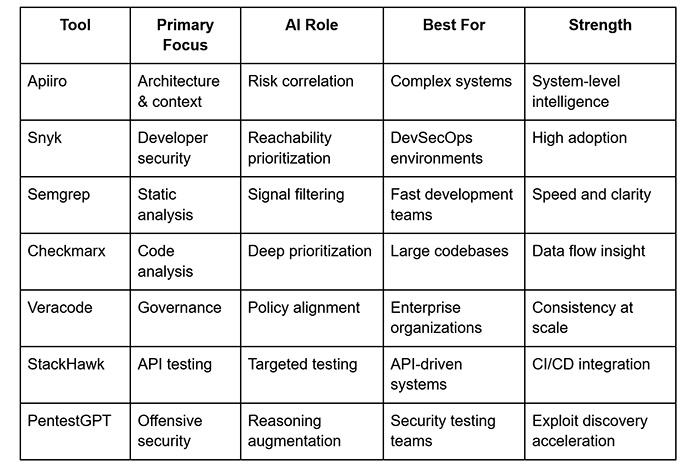
Comparison Table: AI AppSec Tools in 2026
Where AI AppSec Tools Deliver the Most Value
AI AppSec tools do not create value simply by being deployed. Their impact depends on how well they address structural bottlenecks in security decision-making. In most organizations, the problem is not a lack of findings, but a lack of clarity about which findings deserve action, when, and by whom. The environments where AI AppSec delivers the strongest results tend to share specific characteristics.
High-Velocity Engineering Environments
In organizations where deployments happen continuously, the volume of security signals grows rapidly. Every commit, dependency update, and configuration change can introduce new findings. Without intelligent prioritization, security quickly becomes noise.
AI AppSec tools reduce this pressure by compressing large volumes of findings into smaller, prioritized sets. Instead of reacting to every alert, teams can focus on issues that are both exploitable and relevant to current system behavior. This allows security to scale alongside engineering without slowing delivery.
Distributed Architectures and Microservices
Modern applications rarely exist as single codebases. They are composed of services that evolve independently, often owned by different teams. In this environment, risk is not isolated, it propagates.
AI-driven platforms provide value by mapping relationships between services, dependencies, and exposure points. This enables teams to understand how vulnerabilities move through the system, rather than treating each issue as an isolated event. The result is more accurate prioritization and faster remediation.
Resource-Constrained Security Teams
Many organizations operate with limited AppSec headcount relative to their engineering footprint. In these cases, the constraint is not visibility but capacity.
AI helps by reducing the amount of manual triage required. It groups related findings, highlights high-impact scenarios, and provides guidance that accelerates decision-making. This allows smaller teams to operate with a level of efficiency that would otherwise require significantly more resources.
API-First and Integration-Heavy Systems
As APIs become the dominant interface between services, they also become the dominant attack surface. Traditional testing approaches often fail to capture the complexity of API interactions.
AI-enhanced tools improve testing relevance by focusing on how APIs are actually used. They identify critical endpoints, evaluate authentication flows, and prioritize vulnerabilities based on real exposure rather than theoretical risk.
Across all these scenarios, the common pattern is clear: AI AppSec tools deliver value where complexity outpaces human reasoning capacity.
A More Practical Way to Think About AI AppSec Adoption
One of the biggest mistakes organizations make is approaching AI AppSec as a category decision, choosing a “best tool” and expecting it to solve the problem. A more effective approach is to identify where the current system breaks down and introduce AI where it can remove friction in decision-making. This typically falls into three domains:
Interpretation
Teams often struggle to determine which vulnerabilities matter. AI tools that provide contextual prioritization reduce this ambiguity and improve consistency across decisions.
Coordination
Even when priorities are clear, execution can stall due to unclear ownership or fragmented workflows. Platforms that map services to teams and align findings with responsibilities accelerate remediation.
Feedback Loops
Security is most effective when it operates early and continuously. AI tools that integrate into development workflows ensure that findings are addressed when context is still fresh, reducing rework and improving adoption.
Framing adoption in these terms shifts the focus from features to outcomes. The goal is not to deploy more tools, but to create a system where decisions become easier to make.
How to Choose the Right AI AppSec Strategy
Choosing an AI AppSec tool is less about selecting a product and more about understanding where decision friction exists within your organization. In some environments, the primary challenge is interpreting risk across complex systems. In others, it is ensuring that developers actually act on findings. In still others, the bottleneck lies in testing capacity or governance consistency.
A useful way to approach this is to examine how security decisions are currently made:
How are findings prioritized?
How is ownership assigned?
How quickly are issues resolved?
Where do delays typically occur?
The answers to these questions will reveal where AI can provide the most leverage. It is also important to recognize that no single platform solves all problems. The goal is not consolidation for its own sake, but alignment, ensuring that the tools in use reinforce each other rather than operate in isolation. Organizations that succeed with AI AppSec are those that treat it as a decision infrastructure, not just another layer of tooling.